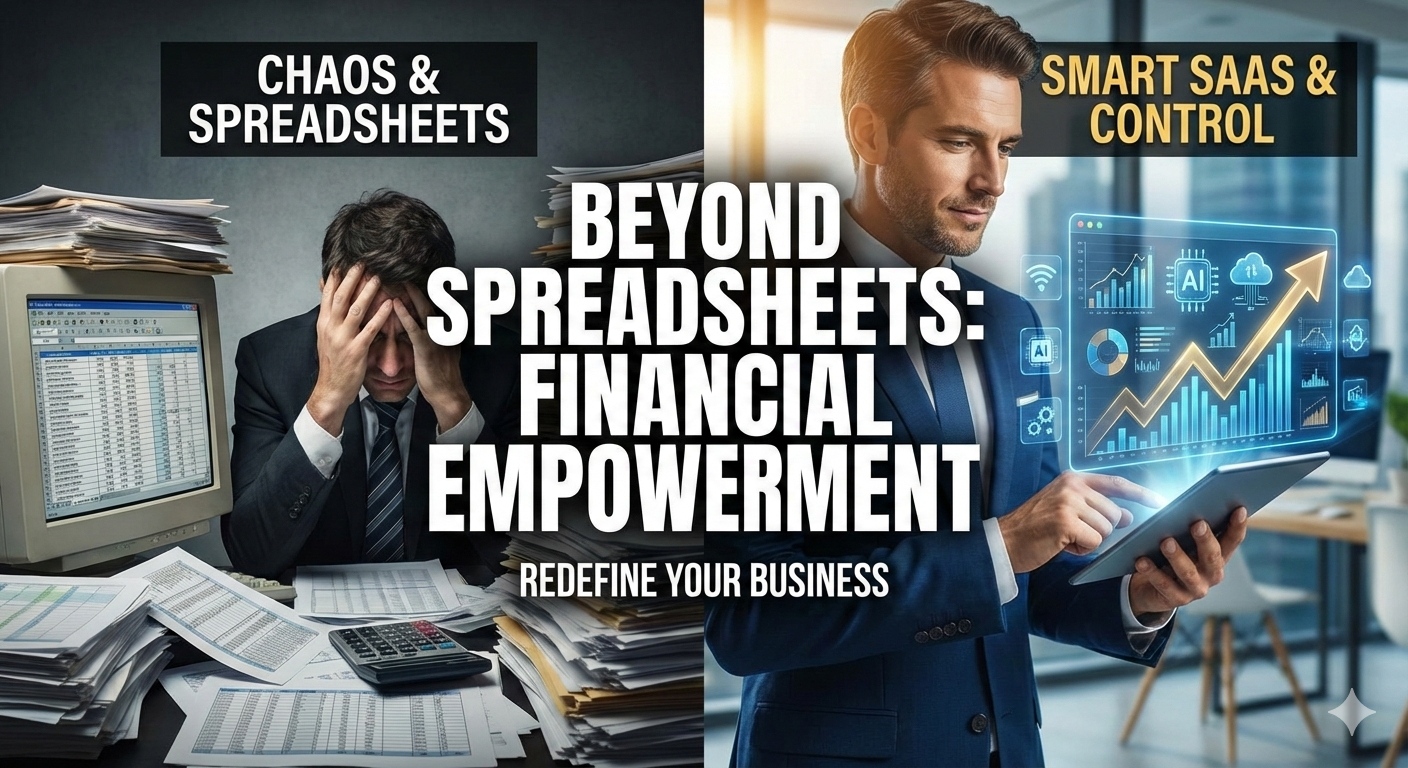
For decades, the small business owner’s weekend ritual has been a silent scream: a kitchen table buried under crinkled receipts, a lukewarm coffee, and the menacing grid of an Excel spreadsheet. You are drowning in data entry, looking at your financial past, praying the numbers add up for the future.
But the wind is changing. We are witnessing the death of “bookkeeping” as a manual chore and the birth of Financial Intelligence as a Service.
Cloud-based accounting isn’t just about moving your shoebox of receipts to a digital folder; it is about fundamentally rewiring the nervous system of your business. As a futurist looking at the trajectory of SME finance, I see a shift from record-keeping to reality-shaping.
Here is how Smart SaaS is handing you the keys to conquer the chaos.
1. From Digital Filing Cabinets to “Financial Nervous Systems”
Most people think “going cloud” just means access from anywhere. That’s the boring part. The radical shift is connectivity.
In the old world, your bank data, your invoice software, and your expense receipts lived on separate islands. You were the boatman rowing between them, manually copying numbers.
In the Smart SaaS future, these islands are bridged by APIs (Application Programming Interfaces).
- The Result: Your bank feed talks to your invoicing software, which talks to your inventory. When a customer buys a product, the inventory updates, the revenue is recognized, and the tax is calculated—instantly, without you touching a key.
- The Shift: You stop being a data entry clerk and start being a data interpreter.
2. The “Invisible CFO”: AI and Automation
The most disruptive force in accounting isn’t the cloud storage; it’s the Artificial Intelligence living inside it. We are moving beyond simple “rules” (e.g., if Starbucks then Meals & Entertainment) to predictive context.
How AI is changing the game:
- Smart Categorization: Machine learning algorithms “read” your receipts. They don’t just see “$50.00”; they recognize the vendor, the context, and the category based on millions of similar transactions across the platform.
- Anomaly Detection: Instead of you hunting for a duplicate invoice at tax time, the system flags it the second it’s uploaded. “You already paid this vendor on Tuesday. Are you sure?”
- Automated Chasing: SaaS tools now automate the uncomfortable part of business—asking for money. Smart systems send polite, escalating reminders to late payers, improving cash flow without damaging relationships.
Futurist Take: Soon, you won’t “do” your taxes. You will simply “review” the return your software has been building, transaction by transaction, every single day of the year.
3. Killing the Rearview Mirror: Proactive vs. Reactive
Traditional accounting is reactive. It is driving a car while looking exclusively in the rearview mirror. You only know you’ve run out of cash after the check bounces.
Smart Accounting SaaS flips your chair around. It turns finance into a proactive engine.
| Feature | The Old Way (Reactive) | The Smart SaaS Way (Proactive) |
| Cash Flow | Checking the bank balance today. | Forecasting: “Based on current spending and pending invoices, you will hit a cash crunch in 14 days.” |
| Spending | Analyzing expenses at month-end. | Real-Time Control: Virtual cards with pre-set limits that block overspending before it happens. |
| Strategy | Guessing if you can afford a new hire. | Scenario Planning: “If revenue drops 10%, can we still afford this salary?” (Answered in seconds). |
The Impact: You stop reacting to fires and start fireproofing your house.
4. David’s Slingshot: Competing with Goliaths
Historically, big enterprises had a massive advantage: armies of accountants and expensive ERP systems (Enterprise Resource Planning) that gave them deep data insights. SMEs were flying blind.
Smart SaaS is the great equalizer. It democratizes “Enterprise-Grade” intelligence.
- Data-Driven Decisions: You can now see Customer Lifetime Value (CLV) or Profit per Project with the same clarity as a Fortune 500 CFO.
- Speed: While big corps are bogged down in approvals and legacy software, your agile SaaS stack allows you to pivot your budget in real-time based on yesterday’s sales data.
- Access to Capital: Modern lenders are using live accounting data (via API) to approve loans in minutes, not months. Your “creditworthiness” is now based on your real-time performance, not your tax return from two years ago.
The Future is “No-Hands” Accounting
We are heading toward a future of Autonomous Finance. The software won’t just tell you what to do; it will ask for permission to do it for you.
“Cash flow looks tight next week. Should I delay the vendor payment to Vendor X by 5 days to keep us in the green?”
By adopting Smart Accounting SaaS, you aren’t just buying software. You are hiring a tireless, 24/7 financial analyst that frees you to do what you actually love: building your business.
The chaos is optional. Control is just a subscription away.
Would you like me to help you compare the top 3 Smart Accounting SaaS platforms specifically for your industry to see which one offers the best “Invisible CFO” features?